Sunday, 29 January 2012

Ninja biken, Sinobigatana, Ninja to?

Although it is hard to say which is actually a real name for this type of sword, he is become not replaceable in training of Ninjutsu.
 
This type of bokken I we make the past ten years, what you could see below is the latest improved version,  in fact, several of them, never do just one solution : ))


and  surprise under Kashira, metsubishi : )


Wednesday, 4 January 2012

Tanrenbo

There is a weapon called Tanrenbo or Furibo, 
although perhaps similar to Tsukubo (the mace), actually serves as a weight, by which we strengthen the hands for later use of sword in Kenjutsu.
It could be classified as Suburito too, 
because their weight is not too heavy,
by their shape, they are still classified as Tanrenbo, 

Today they are used all sorts of things to improve grip strength, but for me personally the best is this classic, traditional and natural tools.
Most of Tanrenbo you could  found is, round, octagonal and square shapes, but I decided for the hexagon shape, for the simple reason that it is harder to make.


Tuesday, 1 November 2011

Daisho

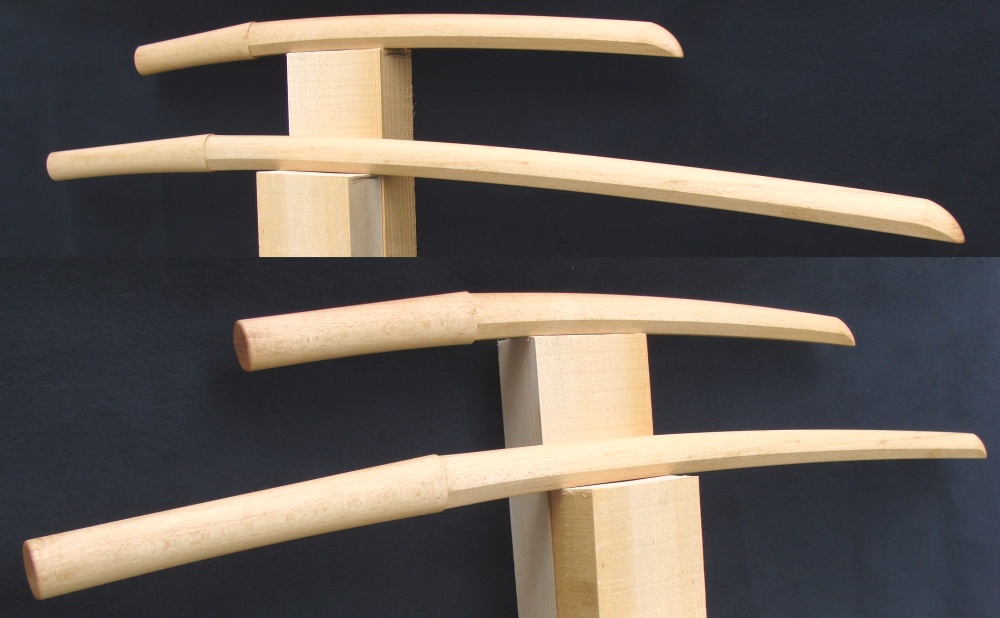
 This is a Daisho bokuto, I called them the basic version,
you may find it similar to other bokken that you can buy, but I assure you it is not.
If you look at the details, curvature, lines, you'll see that I have tried ( in my way) to unify Bokuto and Shinken
I am aware of the fact that any piece of wood or branches, can be used as a bokken or bokuto, but it is valid when you are in nature, and do not bring your bokken with you.

However, when you're in the dojo, and if you respect Budo, then I think it deserves at least one good bokken or bokuto.
In way that person choose Shinken,  the same principle applies equally well to bokken, at least this is my humble opinion.
 
This could be called the most widely used form of blades, although it is actually difficult to say, given the range of the blade, which the Japanese blacksmiths through the centuries have.
Because people mostly purchase a similar type blade, and the curvature is not too large, so it is possible make such a Daisho of exotic wood planks,  I decided that this becomes the basic form of Daisho from my workshop, that's why I called them the basic version


Wednesday, 26 October 2011

Tachi bokken with saya

This is the first tachi bokken with saya, so let the photos speak for themselves,

I did not go too much into the details, anyway this is the first.

Unfortunately with this project I started in 2007, but due to other responsibilities and problems of tool, only recently revived in full.

The pictures show two versions, the first version without saya, bokuto version and another version is Tachi bokken with saya and itomaki with hishigami

And  her is Tachi bokuto without Tachi bokken


more Koryu bokuto

here is two for me new Koryu bokuto, Niten ichi ryu daisho and Shindo Yoshin Ryu bokuto


Thursday, 25 August 2011

training shuko

Hello Buyu's, 
here is older pictures of my new improved Plastic Shuko for training,
tested plastic, rubber spikes, original look, safe for training, 
makes this new Shuko claws ideal 

When I create a weapons for training, the most important to me that this weapon looks like the original as faithfully as possible,
maintaining the original appearance, it is possible to get a realistic feeling during practice, as permitted by technology of making, and characteristics of a material

normally, rubber spikes in this case it would not do what they do steel spikes, but during the practice it is not their purpose anyway.
Since each weapon has a physical aspect, it has also psychological aspect, in this case the mental aspect is met,
if you ask yourself how, in moment when  rubber spikes touch your skin,  
especially facial, 
you will realize that neither the physical (material), aspect is not neglected, because it will be clear to you what would happen to you with metal spikes in this case.
From my humble point of view, meet the  substantive and mental, it is very important in the development of weapons of practice.
Otherwise, it lacks an essential part of practice.
Dose of reality, even an imaginary one, it is important that our training would not be turned into a children's play.
Therefore, equipment designed in this way, helps our awareness during training, because Budo and Sport are not the same thing,
So I hope you understand the difference between cheap equipment, streamlined appearance, mass-made, which some Budoshop's sell,
and this what me and few others are make to improve the quality of practice.


It's also good to know that type of plastic ​​from these Shuko are made, was tested to the pressure of 10 bar=145 psi, which makes them unbreakable

If someone of you visit Hombu Dojo or if you be on Daikomyosai 2009,  you could see that Soke Hatsumi also have one of this shuko, which I gave him as a gift during my visit to Japan 2004, it is one of first versions, but still in one piece

here is video from this Daikomyosai (on 0:30 you could see shuko)


on picture above you could see that wrist ring could be in one piece, or cut it so could fit one anybody's hand, which historically also correct, because there was many variations of this weapon,
also wrist ring could be adapted to your hand if you have bigger hand


Saturday, 6 August 2011

Hira-sankaku Su-yari

Hello my Budo friends,


here is few new pictures of my new Hira-sankaku Su-yari

I improve this type of Yari adding more details like is Kabura maki or Chidome, also new Ishizuki or Hirumaki, on blade in new octagonal Kerakubi, Tachiuchi is wrap better etc.
Enjoy in pictures 


if you think that is all, well my friends there is more :-))